Italian History: A Captivating Guide to the History of Italy and Rome by Captivating History
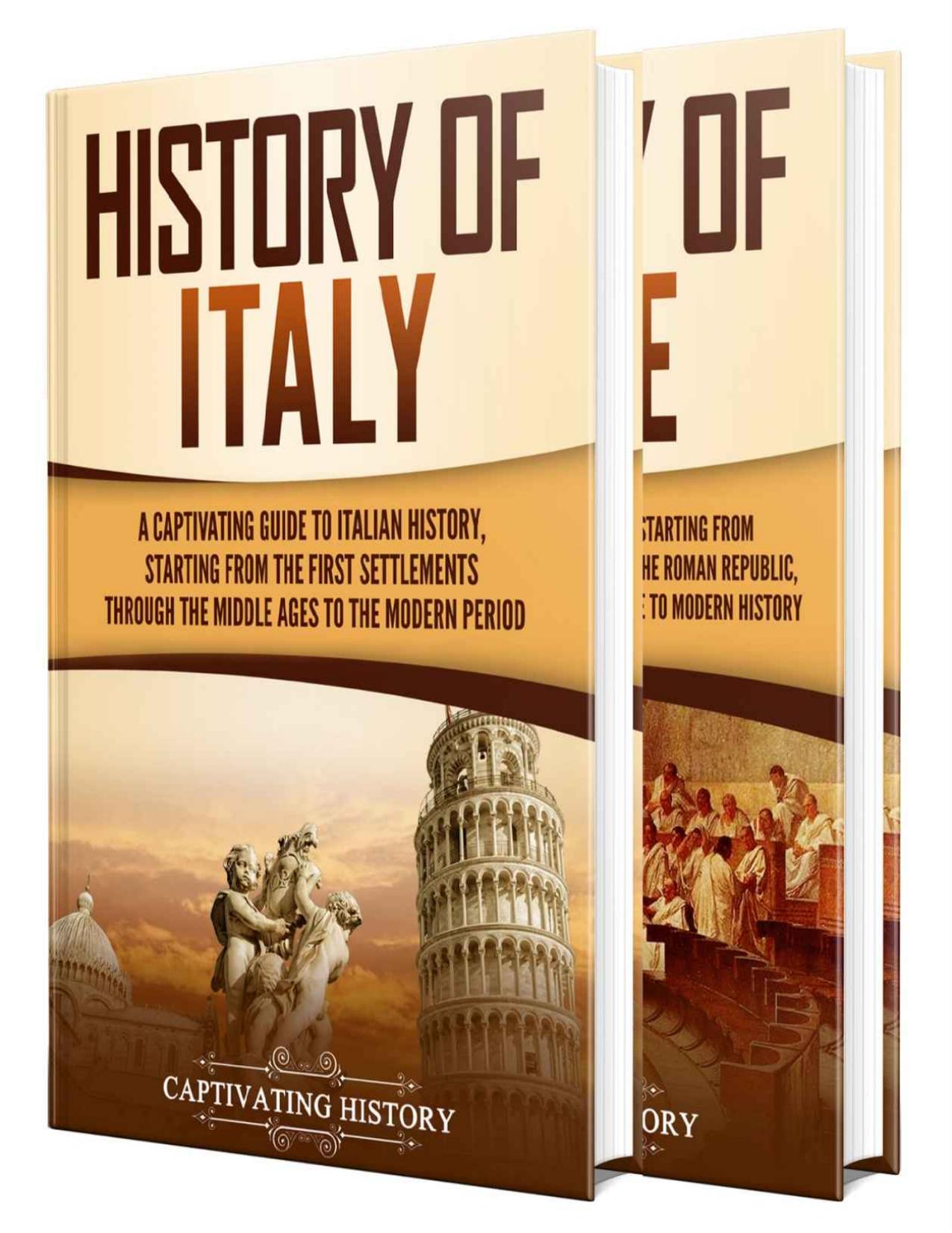
Author:Captivating History [History, Captivating]
Language: eng
Format: azw3, pdf
Published: 2020-11-22T16:00:00+00:00
Chapter 4 â Social Wars and the End of the Roman Republic
The Mediterranean world was opened up to Rome with the end of the Punic Wars and its expansion to Corsica and Sardinia. The 2nd century BCE saw the influx of Greek people, culture, and customs into Italy. Rome found itself under this new Greek influence. Before that, the only contact the two countries had was through the few colonies Greece had in Italy, but these were not enough to majorly impact Rome. Now, it was a different story.
The first athletic games were organized by Scipio Africanusâs brother in 186, and they were modeled on the Greek ones. At the end of the 3rd century, Greek drama and epic poems were introduced as well. By the middle of the 2nd century BCE, a Roman citizen with a higher social status was well acquainted with the Greek way of life. However, this foreign way of life threatened traditional Roman values, and many citizens were aware of it.
The Roman values were based on the fact that everyone was able to live a life of austerity due to the smallholdings around the countryside. Roman citizens had two choices in life: to fight as a soldier or to farm the land. One never excluded the other, and there are numerous stories of soldiers and even dictators who returned to farming their lands after a war. The most famous was the legendary Cincinnatus, a dictator from the 5th century BCE. He even gave his name to the modern-day city of Cincinnati in the United States.
Greek culture introduced a life of softness and leisure to the aristocracy. Rome entered a social crisis, where the aristocracy ignored the power of the Senate and indulged in corruption and bribery.
Social Troubles
Some Roman citizens didnât accept the new way of life that called for pleasure, leisure, and corruption. There was a rising call for social reforms among individuals who enjoyed orgies, brothels, and private parties of the aristocracy. The most vocal among them were two brothers: Tiberius and Gaius Sempronius Gracchus. They quickly realized this Greek influence was not only affecting high society but also the economy of the country. Smallholdings disappeared, making way for big, industrial-type landowners. Many poor people had to leave the countryside, as it no longer offered work, and try their fortune in the large cities.
The Gracchi were a noble family. Their name is connected to five separate consuls of Rome, and the mother of Tiberius and Gaius was none other than Cornelia, the daughter of Scipio Africanus. Cornelia was considered a virtuous woman who abided by all the Roman traditions of the time, and she was determined to keep Rome true to its values. Her ambitions were transferred to her sons, and one could say Cornelia produced the first Roman reformers. In 134, Tiberius was elected as a tribune. This position gave him access to higher politics and granted him the ability to veto the acts of magistrates and the Senate. He was determined to use his power to make a change in the country and to return the land to the small landowners.
Download
Italian History: A Captivating Guide to the History of Italy and Rome by Captivating History.pdf
This site does not store any files on its server. We only index and link to content provided by other sites. Please contact the content providers to delete copyright contents if any and email us, we'll remove relevant links or contents immediately.
The Art of Coaching Workbook by Elena Aguilar(51136)
Trainspotting by Irvine Welsh(21608)
Twilight of the Idols With the Antichrist and Ecce Homo by Friedrich Nietzsche(18602)
Fangirl by Rainbow Rowell(9212)
Periodization Training for Sports by Tudor Bompa(8237)
Change Your Questions, Change Your Life by Marilee Adams(7718)
This Is How You Lose Her by Junot Diaz(6857)
Asking the Right Questions: A Guide to Critical Thinking by M. Neil Browne & Stuart M. Keeley(5741)
Grit by Angela Duckworth(5576)
Red Sparrow by Jason Matthews(5450)
Paper Towns by Green John(5163)
Room 212 by Kate Stewart(5091)
Ken Follett - World without end by Ken Follett(4705)
Housekeeping by Marilynne Robinson(4420)
The Sports Rules Book by Human Kinetics(4367)
Double Down (Diary of a Wimpy Kid Book 11) by Jeff Kinney(4252)
Papillon (English) by Henri Charrière(4238)
The Motorcycle Diaries by Ernesto Che Guevara(4069)
Exercise Technique Manual for Resistance Training by National Strength & Conditioning Association(4048)
